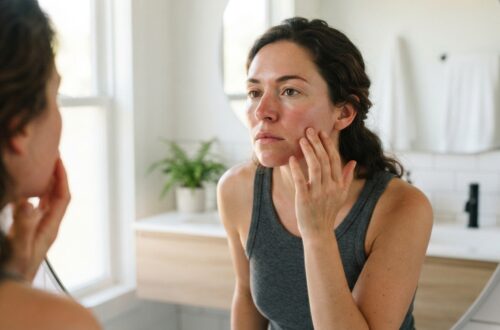
You wake up, look in the mirror, and notice small flakes lifting from your cheeks — the kind that catch the light and make your foundation look patchy by noon. You recently added a hyaluronic acid serum to your routine, and now you’re wondering: does hyaluronic acid make your skin peel? It’s a fair question, and the answer is more nuanced than a simple yes or no. Understanding what’s actually going on with your skin can save you from ditching a genuinely useful ingredient before you’ve given it a real chance.
Hyaluronic acid (HA) is a humectant — an ingredient that works by drawing moisture toward itself. It’s naturally present in your skin, joints, and connective tissue, acting like a cushioning reservoir that keeps cells plump and supported. In skincare, it’s added to serums, moisturizers, and toners to help the skin retain water. It does not exfoliate, dissolve dead skin cells, or trigger cell turnover the way acids like glycolic or lactic acid do. So at first glance, peeling and hyaluronic acid shouldn’t belong in the same sentence.
And yet, here you are. Let’s figure out what’s actually happening.

The Quick Answer: Can Hyaluronic Acid Cause Peeling?
In most cases, hyaluronic acid itself does not cause skin peeling. It has no exfoliating properties and is generally considered one of the gentlest ingredients in skincare. However, peeling can occur in specific situations where HA is involved — usually because of how it’s being used, what it’s being combined with, or what’s happening in the environment around you. The four most common culprits are: product formulation issues, application on dry skin in low-humidity conditions, reactions to other ingredients in the same formula, and skin barrier disruption from overuse of actives.
Why Hyaluronic Acid Gets Blamed for Peeling (When It Usually Isn’t the Cause)
Timing is everything in skincare, and HA often gets introduced to a routine at the same moment someone is also experimenting with retinol, vitamin C, or chemical exfoliants. When peeling starts, the newest addition gets the blame — and that’s frequently the HA serum. But the actual cause is almost always the active ingredient working alongside it, not the hyaluronic acid itself.
Retinol, for example, speeds up cell turnover (the process by which old skin cells shed and new ones surface), which intentionally causes some degree of flaking, especially in the first few weeks. If you’re layering HA under a retinol moisturizer, the peeling you’re seeing is almost certainly the retinol doing its job — not the HA causing harm.
Similarly, if your HA serum contains additional ingredients like niacinamide, fragrance, or alcohol, those could be triggering sensitivity or mild irritation in people with reactive skin. It’s worth checking the full ingredient list rather than assuming the hyaluronic acid is at fault.

The Humidity Problem: When HA Actually Makes Dryness Worse
Here’s where things get genuinely interesting — and where hyaluronic acid can, indirectly, contribute to a flaky, tight-feeling complexion. Humectants like HA need a source of water to draw from. In a humid environment, they pull moisture from the air into your skin. But in a dry environment — think air-conditioned offices, cold winter air, or heated indoor spaces — there’s very little ambient moisture available. In that scenario, HA can pull water upward from the deeper layers of your skin toward the surface, and then that water evaporates off into the dry air around you.
The result? Skin that feels drier and tighter than before you applied anything, and over time, a compromised skin barrier that may begin to flake or peel. This isn’t HA being toxic or harmful — it’s a physics problem. If you want to understand this dynamic more deeply, the relationship between hyaluronic acid and dry skin is worth exploring in full, because the fix is simpler than most people expect.
The solution is straightforward: always follow your HA serum with an occlusive or emollient moisturizer (one that forms a seal over the skin to lock in what the humectant has drawn up). Think ceramide creams, shea butter formulas, or anything with squalane. That extra layer traps the moisture in place and prevents the evaporative loss that leads to flaking.
Is Your Skin Barrier Broken? Signs That Peeling Has a Deeper Cause
Peeling skin isn’t always about what you’re applying — sometimes it signals that your skin barrier is already compromised. Think of the skin barrier as a tightly woven fabric: when it’s intact, moisture stays in and irritants stay out. When it’s damaged — from over-exfoliation, harsh cleansers, or too many actives at once — that fabric starts to unravel. You’ll see flaking, redness, stinging when you apply products, and a general sensitivity that wasn’t there before.
In this state, even gentle ingredients can feel irritating, and hyaluronic acid may seem like the problem when it’s really just the last straw on an already struggling skin barrier. If your skin is reacting to everything right now, the answer isn’t to add more — it’s to strip back to basics: a gentle cleanser, a ceramide-rich moisturizer, and SPF. Give your skin two to three weeks to recover before reintroducing anything else.
One thing worth noting: some people worry that HA might be causing other unwanted reactions too. If you’ve ever wondered whether hyaluronic acid can burn or sting the skin, that’s usually a sign of barrier damage or a reaction to another ingredient in the formula — not the HA itself.

Could the Peeling Be a Pilling Problem in Disguise?
This one catches a lot of people off guard. Sometimes what looks like peeling skin is actually product pilling — when layers of skincare roll up into tiny flakes or balls on the surface of your skin, usually because products haven’t absorbed fully before the next one is applied. Hyaluronic acid serums, especially those with a gel-like consistency, are particularly prone to pilling when layered too quickly or applied over a moisturizer that hasn’t sunk in yet.
If the “peeling” you’re noticing only happens when you’re applying products — or when you rub your face — and not later in the day on bare skin, you’re likely dealing with pilling rather than actual skin flaking. The fix? Apply products in thin layers, wait 30–60 seconds between each step, and always apply HA on the thinnest layer of product (ideally right after cleansing, on slightly damp skin).
Speaking of which, the question of whether hyaluronic acid should be applied on damp skin is one of the most common debates in skincare right now — and the answer matters more than you’d think for getting the best results without triggering any dryness or flaking.
Comparison: Ingredients That DO Cause Peeling vs. Hyaluronic Acid
It helps to see HA in context alongside ingredients that genuinely do cause peeling, so you can make a more informed judgment about what’s happening in your own routine.
- Retinol / Retinoids: Accelerate cell turnover intentionally; peeling is expected in the first 4–8 weeks and signals the ingredient is working.
- AHAs (glycolic acid, lactic acid): Chemical exfoliants that dissolve the bonds between dead skin cells; overuse causes visible flaking and barrier damage.
- BHAs (salicylic acid): Penetrates pores and exfoliates from within; can cause surface peeling if used too frequently.
- Benzoyl peroxide: Antibacterial and drying; commonly causes peeling, especially around the mouth and nose.
- Hyaluronic acid: No exfoliating mechanism. Does not cause peeling directly. May contribute to dryness in low-humidity environments if not sealed with a moisturizer.
The contrast is pretty clear. HA simply doesn’t belong in the same category as these actives. If you’re peeling, look at what else is in your routine before pointing the finger at your HA serum.
One More Concern Worth Addressing: Pigmentation
Some people who notice skin changes after starting HA also worry about discoloration. It’s worth knowing that hyaluronic acid and skin darkening have no established link — HA doesn’t stimulate melanin production or cause hyperpigmentation. Any darkening you notice is almost certainly unrelated to the HA itself.

Products Worth Trying If You’ve Had Peeling Concerns
If you’ve experienced peeling or dryness while using HA and want to rebuild your routine with gentler, better-formulated options, these products are worth considering. Each one is chosen specifically because it pairs HA with barrier-supporting ingredients — reducing the risk of the humidity-related dryness issue described above.
CeraVe Hydrating Hyaluronic Acid Serum
Brand: CeraVe
Key Ingredients: Hyaluronic acid (three molecular weights), ceramides, vitamin B5
Pairs HA with ceramides in the same formula, so it both draws in moisture and helps seal it. Fragrance-free and non-irritating — ideal for anyone whose skin has been reacting to other HA serums.
Neutrogena Hydro Boost Water Gel
Brand: Neutrogena
Key Ingredients: Hyaluronic acid, glycerin, dimethicone
The dimethicone (a silicone that forms a light occlusive layer) helps lock in the hydration the HA draws in — addressing the evaporation problem directly within the formula itself.
The Ordinary Hyaluronic Acid 2% + B5
Brand: The Ordinary
Key Ingredients: Hyaluronic acid (multiple weights), vitamin B5 (panthenol)
Panthenol is a skin-conditioning agent that supports barrier repair — making this a smart pick if your skin is recovering from peeling caused by over-exfoliation or active overuse.
La Roche-Posay Toleriane Double Repair Face Moisturizer
Brand: La Roche-Posay
Key Ingredients: Hyaluronic acid, ceramides, niacinamide, glycerin
Designed specifically for compromised skin barriers. If your peeling is coming from barrier damage rather than HA itself, this moisturizer used over a simple HA serum is a reliable recovery combination.
Inkey List Hyaluronic Acid Serum
Brand: The Inkey List
Key Ingredients: Hyaluronic acid, ethylhexylglycerin
A clean, minimal formula with very few additional ingredients — useful if you’re trying to isolate whether a previous HA product was causing reactions due to other additives rather than the HA itself.

Insider Tips for Using Hyaluronic Acid Without Any Peeling Risk
- Apply on slightly damp skin, then follow immediately with moisturizer. This two-step approach gives HA the surface moisture it needs to work with, while the moisturizer traps everything in before evaporation can occur.
- Don’t mix HA with strong exfoliating acids in the same step. If you use AHAs or BHAs, apply them on their own and let them absorb fully. Layering them directly with HA can sometimes cause temporary balling or pilling that looks like peeling.
- Insider tip: If you live in a very dry climate, consider a HA serum that also contains glycerin or panthenol — these humectants work slightly differently and together they’re more effective at retaining moisture than HA alone in arid conditions.
- Insider tip: Peeling that appears specifically around the nose and mouth is almost never caused by HA — that pattern is a classic sign of retinol irritation or a compromised barrier from over-cleansing. Check your cleanser and actives first.
Frequently Asked Questions
Can hyaluronic acid cause skin purging?
No. Purging (a temporary breakout caused by accelerated cell turnover) only happens with ingredients that speed up how fast skin cells shed — like retinoids and certain exfoliating acids. Hyaluronic acid has no such mechanism, so it cannot trigger a purging response. If you’re breaking out after starting HA, look at other new products or check for comedogenic (pore-blocking) ingredients in the formula.
I stopped using HA and my skin stopped peeling — doesn’t that prove it was the cause?
Not necessarily. If you stopped using HA, you likely also stopped using everything applied around the same time, or you simplified your routine overall. Simplifying a routine almost always reduces peeling because you’re removing the actual culprits (actives, fragrances, alcohol) along with the HA. Try reintroducing a plain, minimal HA serum on its own to test your skin’s actual response.
Does hyaluronic acid expire, and could an old product cause peeling?
Yes, HA products can degrade over time, especially once opened. Expired HA serums may develop a change in pH (the acidity level of the formula), which can cause mild irritation or sensitivity in some skin types. Check the PAO symbol (the open-jar icon on the packaging) and replace your serum if it’s been open longer than recommended — usually 6–12 months.
Can I use hyaluronic acid every day, or does daily use cause problems?
Daily use is generally fine and is actually recommended for consistent hydration. The key is applying it correctly — on damp skin, followed by a moisturizer. Daily use without a sealing layer in dry conditions is where problems tend to develop over time. Once you nail the application method, twice-daily use is safe for most skin types.
What should I do if I’m genuinely unsure whether HA is causing my peeling?
Do a simple elimination test: strip your routine down to cleanser, one plain HA serum, and a fragrance-free moisturizer for two weeks. No actives, no exfoliants, no other serums. If peeling resolves, you know it was something else in your original routine. If it continues, the HA formula itself (not the HA ingredient) may contain something your skin doesn’t tolerate — try a different, simpler formulation.
Conclusion: Hyaluronic Acid Is Almost Never the Villain
So, does hyaluronic acid make your skin peel? In the vast majority of cases, the answer is no — not directly. Hyaluronic acid is one of the most well-tolerated ingredients in skincare, and any peeling you experience while using it is almost always traceable to something else: a co-ingredient, an active you’re also using, low environmental humidity without a proper occlusive layer, or an already-compromised skin barrier that needs time to recover.
The fix is usually simple: apply HA on slightly damp skin, seal it with a good moisturizer, and take a close look at everything else in your routine. If you’re layering retinol, AHAs, or BHAs on top, those are almost certainly the source of any flaking you’re seeing. Give your skin the context it needs to work with HA properly, and it’s likely to become one of the most reliable steps in your entire routine.
If you’re still troubleshooting, explore the full picture: learn about the best way to apply hyaluronic acid for maximum hydration, understand the nuances of hyaluronic acid’s effect on dry skin types, and check whether any other reactions you’ve noticed — like stinging or sensitivity — might be explained by hyaluronic acid and skin burning sensations. The more context you have, the more confidently you can build a routine that actually works for your skin.